
Fishin' Frenzy Strategy
- Provider
- Blueprint Gaming
- Reels × rows
- 5 × 3
- Paylines
- 10
- RTP
- 90%–96.12%
Fishin' Frenzy strategy: paylines, RTP and free spins
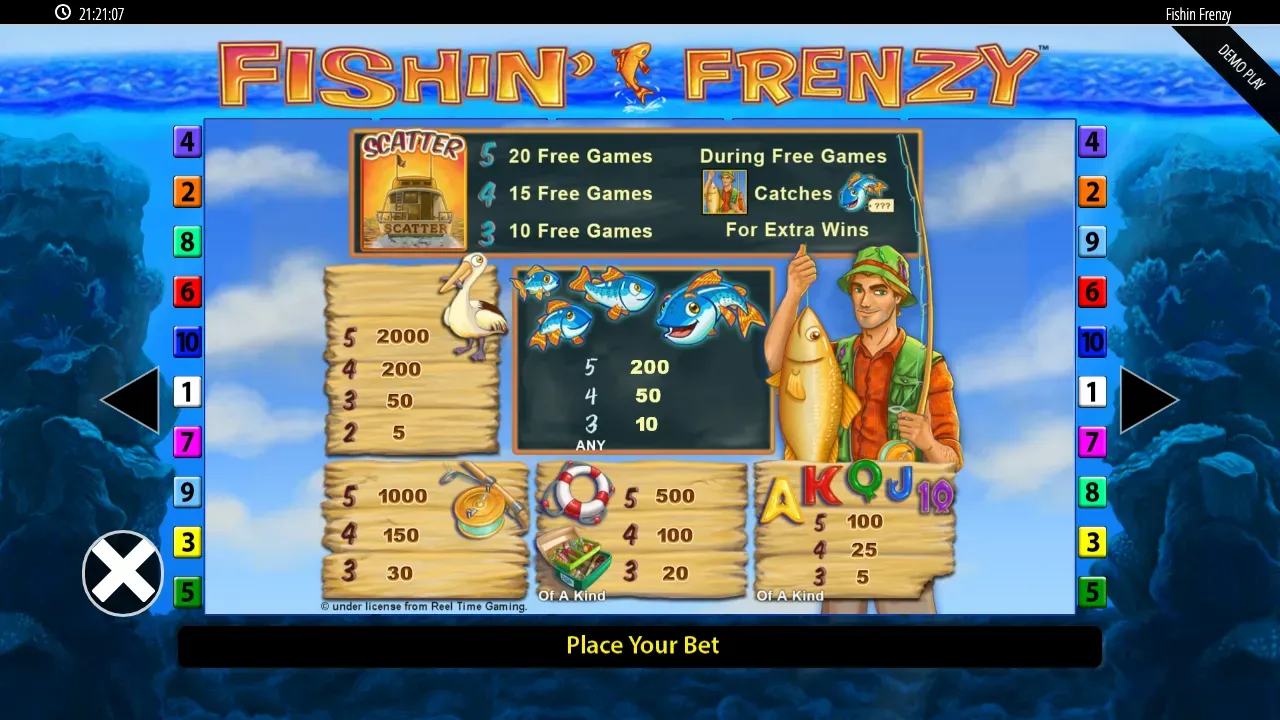
Three, four or five Boat scatters award ten, fifteen or twenty free spins in the original online rules. During those spins, each Fisherman collects all visible fish tags separately. Two Fishermen collecting tags totalling 7× produce a 14× collection, illustrating why the collector count matters.
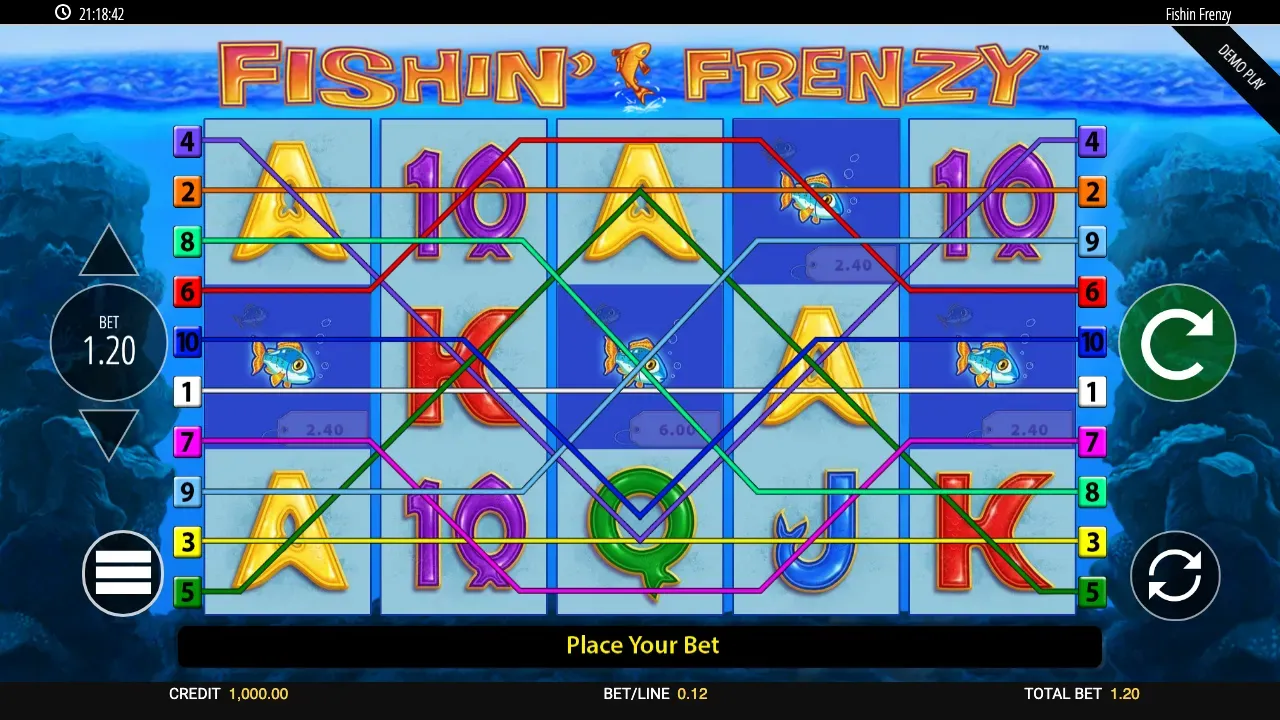
Ten fixed paylines remain active together. With a £1 total stake, each line carries 10p; a payout of 100 line-stake units on one line therefore equals £10. Fish tags use the total stake instead. Checking that distinction prevents misleading comparisons between screenshots.
Blueprint lists 96.12%, 94%, 93%, 92% and 90% RTP configurations. Read the casino version's information screen for the applicable figure. RTP describes theoretical long-run return, so it belongs in a version comparison rather than a prediction for your next session.
| Provider | Blueprint Gaming |
|---|---|
| RTP | 96.12% / 94% / 93% / 92% / 90% |
| Reels × rows | 5 × 3 |
| Paylines | 10 |
Low-stake Fishin' Frenzy tips
Use the demo explanation to learn the controls and paytable with virtual credits, or read the rules without playing. If your question is how collection works, identifying the fish and Fisherman's roles answers it without waiting for a particular result.
For money play, a smaller stake commits less to each spin. Ten spins at 20p cost £2 in total stakes, compared with £10 at £1 per spin, before counting any returns. This simple arithmetic is the useful comparison when choosing an affordable level.
Set a separate time limit as well as a spending limit. Repeated small stakes still add up, and neither limit needs to depend on seeing free spins first.
Playing Fishin' Frenzy with a fixed stake
A fixed stake keeps the cost of each round clear. You can compare the visible balance with your starting allowance without recalculating a changing stake after every result. It also keeps the displayed fish multipliers on a consistent money basis.
For example, a 5× fish tag represents £1 at a 20p total stake whenever the feature's collecting conditions are met. Keep that relationship in mind when comparing a tag with the stake control. A bigger displayed value may simply reflect a bigger stake.
Review the budget away from the reels and stop at the planned limit. Keeping a stake consistent makes spending easier to follow; it provides no control over when Boats or Fishermen land.
Fishin' Frenzy staking systems and loss chasing
Raising stakes after losses increases the amount committed to the next result. A doubling sequence grows quickly: 20p, 40p, 80p and £1.60 total £3 before any further round. That is spending arithmetic, with no guarantee that a later win covers it.
Chasing free spins has a similar problem. The trigger is the Boat combination, rather than a personal spending threshold. A fixed plan to stop after a set time or amount gives you a clear endpoint even when the feature has not appeared.
If you start changing the plan to recover money, close the game and review the actual spending. Our support information covers breaks, account tools and self-exclusion when stopping becomes difficult.
Fishin' Frenzy strategies compared
| Approach | Practical effect | Point to remember |
|---|---|---|
| Demo or rules only | Learn the interface without money stakes | Virtual credits have no cash value |
| Smaller fixed stake | Lower commitment per round | Repeated rounds still add up |
| Time and money limits | Clear stopping points | Keep both independent of feature triggers |
| Increasing after losses | Higher commitment on later rounds | No assured recovery |
The useful comparison is how much you commit and when you stop. Keep those choices separate from volatility descriptions, which vary between published versions of the original.
Managing your Fishin' Frenzy budget
Choose an entertainment allowance from money left after bills, savings commitments and other essentials. Keep borrowed money outside that calculation. Treat the allowance as the maximum you are prepared to spend, and count winnings as money you can keep rather than money that must return to the reels.
Use available account limits and set a reminder away from the game. At the stopping point, check the actual time and money spent. A move to another device or service belongs to the same personal budget, so keep the total in view.
The responsible gambling page explains warning signs, support and exclusion options. Help is available as soon as gambling causes concern, including when you repeatedly adjust a limit that you intended to keep.
Fishin' Frenzy strategy FAQ
Can you beat Fishin' Frenzy with a strategy?
No staking method guarantees a profit or controls the next outcome. Understanding the mechanics can prevent mistakes in reading results, while limits help control exposure. Neither removes the risk of losing money.
Does a larger stake trigger more free spins?
The documented trigger is three or more Boat scatters. Increasing the stake increases the money committed to each round; it supplies no assured route to an earlier feature. Use your version's rules to check the trigger.
Can demo practice improve your winning chances?
Demo play helps you find the paytable, recognise the symbols and read collections. Keep that knowledge separate from predicting paid results, and check the paid game's RTP configuration independently.
When should you stop playing?
Stop at your planned time or money limit, or sooner if play feels uncomfortable. If you feel compelled to recover losses or keep going until a feature arrives, leave the game and consider independent support.